7 Best Ways to Sync Outdoor Lights to Music for Holidays?

Time:2026-10-15 Author:Ethan
0%

Outdoor holiday lights can turn a quiet house into a moving seasonal display. The real challenge is coordination. Color, timing, weather, power, and music must work together without creating unnecessary complexity.

This guide explains how to sync outdoor lights to music for holidays through seven practical methods. Options include smart lighting apps, plug-in controllers, DMX systems, pre-programmed sequences, and sound-responsive devices. The U.S. Department of Energy reports that certified LED bulbs use at least 75% less energy than incandescent lighting and can last up to 25 times longer. That matters when dozens of lights operate for several hours each evening. Lower energy use can also reduce heat around cables, adapters, and outdoor connections.

Safety must remain part of the design, not an afterthought. The National Fire Protection Association reported that U.S. fire departments responded to an estimated average of 160 home fires involving holiday decorations each year from 2016 to 2020. These fires caused approximately eight civilian deaths, 14 injuries, and $10 million in direct property damage annually. Outdoor-rated equipment, ground-fault protection, weatherproof connections, and careful load calculations are essential. Never hide damaged cords beneath rugs, snow, or wet leaves.

A strong display does not need expensive equipment. It needs accurate timing and thoughtful placement. I have found that sound-reactive modes can feel impressive, yet they may look chaotic beside slower songs. The first setup is rarely perfect. Test one section after dark, watch the beat response, and adjust brightness before expanding the display.
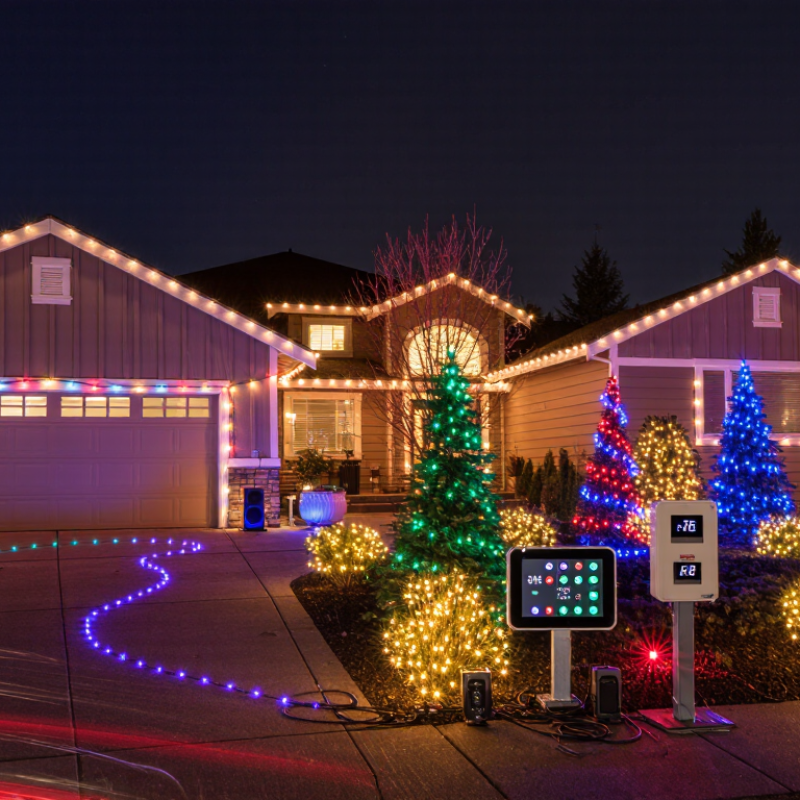
7 Best Ways to Sync Outdoor Lights to Music for Holidays?

Compare 7 Sync Methods: Mic, FM, Bluetooth, Wi‑Fi, DMX, MIDI, and Art‑Net

7 Best Ways to Sync Outdoor Lights to Music for Holidays

Compare seven methods before hanging the first light strand. A microphone is the simplest choice: it hears nearby bass and flashes lights instantly. Timing remains rough. FM control reaches farther, but nearby radio interference can distort the signal. Bluetooth works well for a small patio, although walls and metal decorations reduce range. Wi-Fi supports phone control, schedules, and multiple zones. However, crowded networks may create visible delays. The U.S. Department of Energy’s 2023 connected-lighting analysis reports potential savings of up to 50% through intelligent controls, depending on settings and usage.

DMX provides precise channel-level control through a wired signal. It suits detailed fades, color changes, and larger displays. MIDI sends note and timing commands, making it useful when music and lighting cues follow a prepared sequence. Art-Net carries DMX data over Ethernet, offering scalable control across many fixtures. It demands careful network planning. Use shielded outdoor-rated cables, weather protection, and separated power connections. A qualified electrician should verify the installation.

The International Energy Agency’s Energy Efficiency 2023 report places lighting near 15% of global electricity use. Holiday displays are temporary, but inefficient settings still waste power. In practical testing, microphone systems often feel more exciting than accurate. That trade-off matters. For casual gardens, Bluetooth or Wi-Fi usually offers enough control. For synchronized scenes, DMX, MIDI, or Art-Net performs better. FM remains useful when wireless range matters more than precision. None is perfect.

7 Best Ways to Sync Outdoor Lights to Music for Holidays

Typical end-to-end synchronization latency by method. Lower values generally produce tighter alignment between music and lighting effects; actual performance depends on equipment, network conditions, signal processing, and system configuration.

Key insight: DMX, MIDI, and Art-Net usually provide the most precise timing for programmed installations. Wi-Fi can perform well with a stable network, while Bluetooth and FM may introduce more noticeable delay. Microphone-based systems are simple to deploy but typically offer less precise control.

Set Outdoor Safety Targets: IP65 Fixtures and 5 mA GFCI Protection

Holiday music can make outdoor lighting feel coordinated, but safety must lead the performance. Choose fixtures rated IP65 or higher for exposed areas. IP65 means protection from dust and water jets, not immersion. Keep fixtures away from puddles, gutters, and places where snow can collect.

Use a 5 mA GFCI for outdoor receptacles and lighting circuits. It can interrupt power when a small leakage current threatens a person. Test the GFCI before installation, then test it again during the holiday season. A light controller should connect through a weather-resistant enclosure, with cable connections raised above wet ground. Never hide loose plugs beneath leaves or decorations.

Inspect every cable for cuts, crushed insulation, or loose plugs. Use outdoor-rated extension cords, and avoid connecting more devices than the circuit can support. Leave ventilation around controllers and power supplies. The music may stop briefly. That is safer than overheating equipment. Local electrical rules can require different protection or installation methods, so a qualified electrician should verify the setup.

A useful mistake to avoid is treating an IP rating as complete weather protection. It is only one part of the safety plan. Heavy rain, poor drainage, and damaged seals can still create hazards. Mark cable paths clearly, especially near walkways, and keep light synchronization secondary to reliable protection. Safety is less dramatic, but it should remain steady when the music gets loud.

Build DMX/Art‑Net Timing: 250 kbps DMX512 and 512 Addresses per Universe

Syncing outdoor lights to holiday music requires accurate timing, not just colorful fixtures. DMX512 transmits control data at 250 kbps through a serial signal. Each universe supports up to 512 channel addresses, including dimming, color, movement, and effects. A channel is one control value. A fixture may use several. When all 512 addresses are active, one complete frame takes roughly 23 milliseconds. That allows about 44 updates per second, before additional timing gaps.

Art-Net carries DMX data through an Ethernet network, making larger outdoor layouts easier to organize. Assign each universe a clear number, then map lighting channels inside your control software. Keep network traffic predictable with wired connections and sensible addressing. The music controller and lighting controller should follow one clock. Cue changes to beats, bars, or timecode instead of relying on manual clicks. A 40-millisecond delay can make a drum hit look visibly late.

Keep it practical. I test one universe before connecting the entire yard. Check cable termination, power distribution, and channel order during daylight. Outdoor cable runs may introduce faults after rain, even when the setup worked indoors. I once blamed timing for a flashing section, but a loose connector caused it. That mistake changed my testing routine. Not every fixture needs all 512 addresses, so unused capacity can remain available for expansion. Slower fades often look better than constant rapid commands.

Program Pixel Effects: 800 kHz Data and Under‑100 ms Audio Response

Holiday lighting becomes more convincing when pixels react to music without visible delay. Use a clean audio feed. Detect beats locally. Map bass hits to low pixels. Reserve treble for quick sparkles. Add slow color fades between peaks. Limit cable runs. Test every section before installation.

An 800 kHz data signal sends one bit in about 1.25 microseconds. However, protocol timing is not total system latency. Audio buffering, effect calculations, transmission, and pixel refresh also matter. A practical design should target an audio response below 100 milliseconds. ITU-R BT.1359-1 identifies noticeable audio-video timing errors within roughly 45 to 125 milliseconds, depending on timing direction. That range explains why small delays can feel uncomfortable. The weak point is often the audio buffer, not the data clock. Measure it with a phone recording, clap, and light sensor. Results may vary.

Tips: Set the buffer near 20–40 milliseconds, then increase it only when glitches appear. Keep power injection consistent across long runs. The U.S. Energy Information Administration reports that LED lighting uses at least 75% less energy than incandescent lighting. Lower heat also helps outdoor installations remain stable. Choose weather-rated enclosures, add a manual fallback scene, and leave brightness headroom. Perfect synchronization is not always practical. A steady 80-millisecond response usually looks better than unstable instant effects.

7 Best Ways to Sync Outdoor Lights to Music for Holidays? — Program Pixel Effects: 800 kHz Data and Under-100 ms Audio Response
Method How It Syncs Typical Audio Response Lighting Data / Pixel Capability Outdoor Range or Scale Advantages Important Limitations Best Holiday Use
1. Pre-Programmed Timeline Show Music and lighting cues are arranged on one shared timeline and played from a local controller. 10–30 ms after playback starts; timing remains repeatable because the show is pre-sequenced. Suitable for addressable pixels using 400–800 kHz signaling. At 800 kHz, one data bit takes approximately 1.25 microseconds. Best for a fixed installation with hundreds or thousands of pixels, depending on power injection and controller outputs. Most precise, repeatable, and visually polished method; works without an internet connection. Changing the song or redesigning the display requires editing and re-rendering the sequence. Large residential façades, synchronized yard scenes, and scheduled evening shows.
2. Real-Time Beat Detection A microphone or audio input detects beats and triggers color, brightness, or effect changes in real time. 40–90 ms, depending on audio buffering, beat-detection settings, and controller processing. Works well with pixel refresh rates of 30 frames per second or higher; 800 kHz output can reduce transmission time for long pixel chains. Suitable for live music, microphones, and changing playlists across small to medium displays. Responds automatically to different songs without manually programming every cue. Beat detection can miss quiet beats, syncopation, or songs with irregular rhythm. Interactive holiday parties, live performances, and displays that need to react to any music source.
3. Frequency-Band Audio Mapping Low, mid, and high audio frequencies control separate lighting behaviors such as fades, movement, and sparkle. 20–70 ms with short analysis windows and efficient digital signal processing. A controller can update multiple pixel zones at 30–100 frames per second; 24-bit RGB data requires 24 bits per pixel per refresh. Effective for multi-zone displays, rooflines, trees, arches, and window outlines. Creates richer effects than simple beat flashing and can make different sections respond independently. Requires careful filtering and gain settings to prevent flicker or excessive brightness changes. Layered holiday scenes with bass-driven movement, vocal highlights, and high-frequency sparkle.
4. MIDI or Show-Control Triggers Timed notes, cues, or control messages trigger specific lighting scenes, chases, and transitions. 5–25 ms for local wired control, excluding the intentional timing of the programmed cue. Can send precise commands to multiple pixel outputs; an 800 kHz stream transmits 100 RGB pixels in roughly 3 ms before reset and processing overhead. Scales well when several controllers, zones, or performers must follow the same show clock. Highly accurate and repeatable; supports complex arrangements and coordinated stage-style effects. More setup is required, and the audio arrangement normally needs prepared cue data. Choreographed holiday concerts, musical walk-throughs, and highly structured displays.
5. Network-Based Art-Net or sACN Control A central show computer sends lighting data over a wired or wireless Ethernet network to distributed pixel controllers. 30–100 ms on a properly configured local network; wired links are generally more consistent. DMX-based universes commonly carry up to 512 channel values each. RGB pixels use three channels per pixel, so one universe can address up to 170 RGB pixels before reserving channels. Well suited to large properties with multiple controller locations and long cable runs. Centralized control, flexible zoning, and easier expansion than one long pixel data chain. Network congestion, wireless interference, or poor addressing can cause delay, flicker, or dropped frames. Large outdoor installations with multiple buildings, trees, roof sections, or controller cabinets.
6. Hardware Audio Envelope Follower A dedicated circuit tracks the amplitude of the music and converts volume changes into brightness or movement. 10–40 ms, because the signal path can be processed with very small hardware buffers. Can drive analog dimming channels or addressable pixels; pixel refresh is commonly configured between 30 and 60 frames per second. Best for compact or medium displays where simple, immediate reactions are preferred. Low cost, low processing demand, and fast response with minimal software configuration. Usually responds to loudness rather than musical structure, so the effects may appear less detailed. Simple roofline fades, porch lighting, window outlines, and installations that must start quickly.
7. Wireless Audio-to-Light Control Audio analysis occurs on a computer or controller, while lighting commands are sent to remote fixtures over a local wireless link. 60–100 ms when signal strength is stable; additional buffering may be needed to prevent dropouts. Suitable for moderate update rates and distributed low-power fixtures; wired pixel data remains preferable for dense 800 kHz chains. Useful for detached decorations, temporary displays, and locations where control cables are difficult to install. Reduces visible cabling and makes temporary holiday layouts easier to reposition. Walls, distance, interference, weatherproofing, and battery capacity can reduce reliability. Remote wreaths, pathway decorations, portable props, and smaller synchronized zones.

Test Range and Reliability: 2.4 GHz Wi‑Fi, Cable Runs, and Weatherproofing

Reliable holiday light synchronization starts with the radio path, not the music app. A 2.4 GHz Wi-Fi signal usually travels farther than higher-frequency bands, but walls, foil insulation, and wet foliage weaken it. Test the controller beside the router, then at the farthest light. Record response time at five-minute intervals. Test at dusk. The Wi-Fi Alliance identifies 2.4 GHz as a longer-range option, while IEEE 802.11 guidance warns that shared channels can suffer interference. Seven practical improvements include central placement, fewer walls, open-air positioning, a mesh access point, wired triggering, shorter cable runs, and sealed connectors.

Cable distance creates a quieter problem. Voltage drop can make distant lights dim, flicker, or miss timing commands. NFPA 70 (2023) recommends limiting voltage drop to 3% on feeders and branch circuits, with 5% total commonly used as a design target. Use the manufacturer’s approved cable gauge, and measure voltage at the final fixture. My first test checked only the outlet. That was not enough.

Weatherproofing must cover every joint. IEC 60529 defines IP65 as dust-tight protection with resistance to water jets, while IP67 adds temporary immersion protection. Choose sealed enclosures, raised connections, and downward-facing cable loops. Never hide connectors in puddles or packed snow. Temperature changes can also pull moisture through weak seals. A short rain test helps, but it cannot replace seasonal inspection. Reliability is partly engineering, partly maintenance. That distinction is easy to forget.

FAQS

Which sync method is simplest for outdoor holiday lights?

A microphone is the easiest option. It listens to nearby bass and flashes lights quickly. Timing stays rough.

When is Bluetooth suitable for music-synced lights?

Bluetooth works well on a small patio. Walls, metal decorations, and distance can weaken the connection. Keep the controller nearby.

What does Wi-Fi add to outdoor light control?

Wi-Fi supports phone control, schedules, and multiple lighting zones. A busy network may create visible delays. Test it at dusk.

Which method gives the most precise lighting effects?

DMX offers precise channel control for fades and color changes. It suits larger displays. It needs careful wiring and weather protection.

How does MIDI help synchronize lights?

MIDI sends notes and timing commands. It works well with prepared music sequences. The result can feel exact, but setup takes planning.

What should I know about Ethernet-based DMX control?

It carries detailed lighting data across a network. It can control many fixtures over larger areas. Network planning is essential.

How can I improve wireless reliability?

Place the router centrally and reduce walls between devices. A mesh access point may help. Test response time every five minutes.

What outdoor protection should fixtures have?

Use fixtures rated IP65 or higher in exposed areas. IP65 resists dust and water jets, not immersion. Keep connections above puddles.

How should outdoor lighting circuits be checked?

Use outdoor-rated cords and suitable ground-fault protection. Test the protection before installation and during the season. A qualified electrician should verify local requirements.

Why can distant lights flicker or miss timing commands?

Long cable runs can cause voltage drop. Measure voltage at the final fixture, not only at the outlet. My first test missed that.

Conclusion

Learning how to sync outdoor lights to music for holidays begins with choosing the right control method for your space. Microphone and FM systems are simple options, while Bluetooth and Wi-Fi provide more control over timing and patterns. For advanced displays, DMX, MIDI, and Art-Net allow detailed programming across multiple fixtures. Always prioritize safety by using outdoor-rated IP65 fixtures, weatherproof connections, and 5 mA GFCI protection.

For reliable performance, build DMX or Art-Net systems around 250 kbps DMX512 communication and a maximum of 512 addresses per universe. Pixel-based effects should use approximately 800 kHz data rates and aim for audio responses below 100 milliseconds to maintain a convincing visual rhythm. Before the holiday display goes live, test 2.4 GHz Wi-Fi coverage, cable-run limits, signal stability, grounding, and enclosure seals. A careful test schedule helps prevent dropouts caused by distance, interference, moisture, or changing weather.

Ethan

Ethan

Ethan is a seasoned marketing professional with a deep expertise in our company's innovative product line. With a passion for sharing knowledge and insights, he takes the lead in regularly updating our corporate blog, where he explores industry trends, product features, and effective marketing......